Big news! As part of Future Proof Games, I’m remastering my classic Flash art game “The Majesty of Colors” for modern technologies. Instead of Flash, the game will be available natively for Windows, OSX, Linux, iOS, and Android. We’re polishing some rough edges but otherwise staying true to the original.
This feels very odd! “(I Fell in Love With) The Majesty of Colors” is one of the first games I made that got any attention and remains one of my most-recognized games. It can be a bit frustrating sometimes that a game I made almost eight years ago is more familiar to folks than my recent work, but the truth is that “Majesty” is one of my favorite projects I’ve worked on, along with Looming, Ossuary, and Exploit: Zero Day. Out of all my games that are becoming inaccessible due to the fading of Adobe Flash, “Majesty” is the one I most want to preserve.
I’m hoping that there’s an audience for weird little art games in the modern gaming world, especially on Steam. If you think there is, please vote for us on Steam Greenlight.
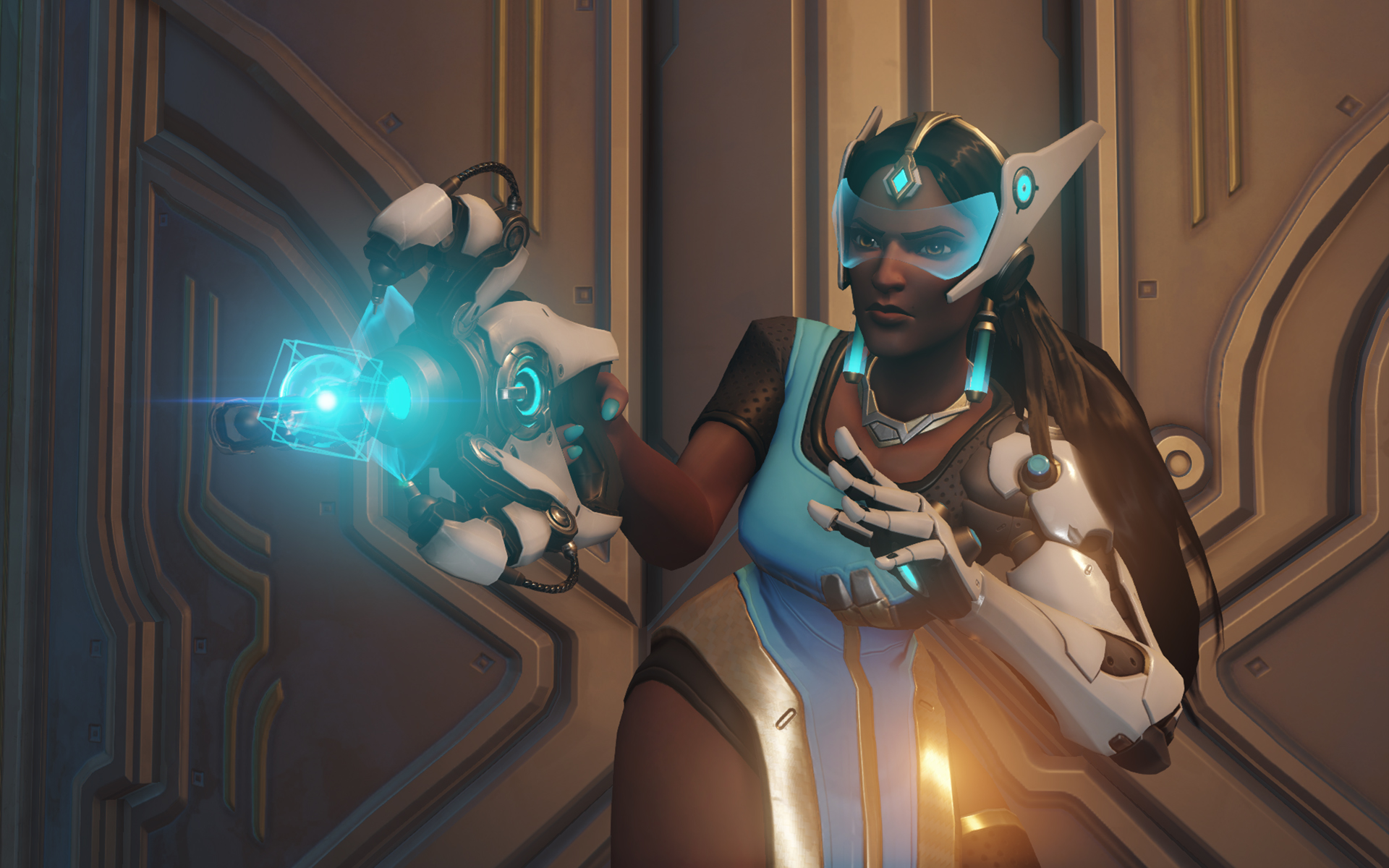
Symmetra is the most strangely-designed character in Blizzard’s Overwatch. In a game where most heroes’ roles can be summed up in a few words (“fast flanker,” “mobile area-denial tank,” “AOE healer,” “slowing defender”) and their story concepts naturally arise from their roles (“time-traveling jet pilot,” “leaping electric gorilla,” “portable DJ,” “cute ice Satan”1), Symmetra makes little sense.
She builds many tiny sentries, gives minor shields to allies, builds teleporters, and can attack with either a short-range cumulative auto-aim beam or a slow-moving death orb. This is explained by her being a combination architect and sci-fi construction worker, shaping solid forms out of light. She is the only character with “photonic” technology, and it is not explained how being able to project physical holograms also lets you bend space and time to craft a teleportation portal.
I have no special insight into the Overwatch design process, but I can speculate with some confidence about how it proceeded. Symmetra (and indeed all the heroes) were not designed from the ground up. They were assembled using an accretive process, where abilities were assembled piecemeal and then unified with a story-based concept. Continue reading Strange Symmetra: Accretive Design in Overwatch→
I’ve read one too many “git gud” posts arguing that challenge is essential to games and that including an easy mode on, say, Dark Souls would ruin it; if you don’t want a hard game, don’t play Dark Souls. They’re wrong. Firstly, challenge isn’t an inherent aspect of games: it’s just one way of evoking certain player responses. Challenge is partly a personal preference thing: some people want a smooth experience and I do think that Dark Souls is a poor choice for that, and that experiencing Dark Souls as a cake walk won’t let you understand Dark Souls.
But that’s not the point. My perspective was summarized pretty eloquently by Rob Fearon but I feel like it can be distilled even further. The argument: what is hard for you might not be hard for me.
Wolfenstein: The New Order, developed by MachineGames and published by Bethesda, should have been awful. If you’d asked me before release, I’d have predicted that the ninth game in a franchise, an alternate-history game set in the 1960s where the Nazis won World War II, featuring B.J. Blazkowicz as a recovered locked-in veteran, would only be good for a few hot takes and maybe some mediocre shooting with nose firmly held.
Instead, this game is one of the best I’ve played. It’s not just great, it’s well-crafted. That is to say that, beyond the things that appeal to my personal preferences (alternate history, cool sci-fi, a diverse cast, a dark tone, a considered pace) it shows great skill in how it executes what it sets out to do.
The credit for this success belongs to various factors—the expressive visual art, the excellent voice acting, and the well-polished rule systems—but more than anything, it’s thanks to the excellent writing.
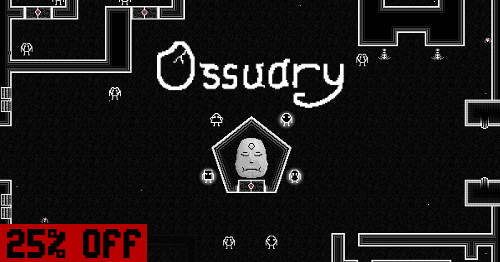
Our 2013 game Ossuary is currently on sale for $7.49 on Steam!
I wrote all of Ossuary and released it with my partner as the first project of Future Proof Games. It’s a little game that’s pixelly and funny and strange. You’re a newcomer to a macabre philosophical underworld, and to escape you have to solve conversation-based puzzles and use sins as inventory items. I used it to explore a lot of Discordian concepts and perspectives, so in a sense it’s a religious work for me.
It’s weird looking back on Ossuary. I’m really proud of how it turned out, although it’s never had real financial success. We’ve sold maybe a couple thousand copies. For now it’s paying Future Proof’s monthly expenses for servers and such, but it’s certainly not making enough to provide us with paychecks. Each sale on Steam helps a bit, though, so if you haven’t picked up the game, check it out! It’s cheap! (And hey, if you know someone you think will like Ossuary, you can always get it for them as a gift!)
And a final request: if you have played Ossuary, please do leave a Steam review. Our 17 reviews are 94% positive, but Steam won’t list them as “Very Positive” or “Overwhelmingly Positive” until we have enough of them. Anecdotal evidence strongly suggests that these categories make folks more likely to check out an otherwise-unknown game.
Screenshot of Hyper Light Drifter from Steam user 芊一.Hyper Light Drifter, from Heart Machine1, is an inscrutable game: one which presents you with various mysteries and challenges, inviting you to overcome them, but doesn’t bother guiding you along that path. It’s part of a new trend in so-called “retro-inspired” games that recontextualizes the challenge and low fidelity of console game from the 1980s as intentional, stylistic choices. Because of these choices, it has limited accessibility but provides a specific mood and emotional journey that would be difficult to evoke in a more populist game.
In this episode of the Ludus Novus podcast, I discuss incremental games, also known as idle games or clickers. How did a formula that started as satirical jokes from people like Ian Bogost yield things like A Dark Room? Games discussed: Cow Clicker, Progress Quest, Candy Box, Cookie Clicker, A Dark Room.
I love it when games wear their math on their sleeves. I also like when games are based on real-life systems, even when those systems are twisted or simplified for the purposes of smoother design. Pandemic is a good example of the former: the way the Infection deck is constructed and manipulated makes it clear how the game’s randomness works and why the same cities keep breaking out in more and more disease. Spacechem is a good example of the latter: it takes the concept of chemical bonds and process engineering and turns it into a brain-twisting puzzler.
Pocket Frogs, by Nimblebit, does both of these things. It takes the concept of genetic inheritance and uses it to make a sort of gambling game where the math is always visible and calculable.
It’s a game where you breed frogs, trying to produce certain special collections. But let’s pretend it’s not.
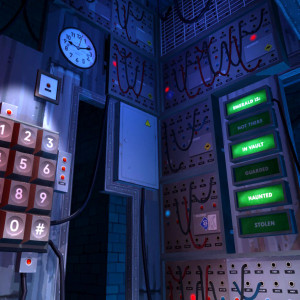
Dr. Langeskov, The Tiger and The Terribly Cursed Emerald: A Whirlwind Heist is a weird little free game that’s a whole lot like the demo to The Stanley Parable, which was designed by the same person. No, not Davey Wreden, the creator of the original mod; his followup game is The Beginner’s Guide, a first-person experiment in form that explores the creative process as relates to video games, inspired in part by the impostor syndrome triggered by unexpected popularity. Heist is designed by William Pugh, who worked with Wreden on the standalone remastering of Stanley, and this followup is a first-person experiment in form that explores the creative process as relates to video games, inspired in part by the impostor syndrome triggered by unexpected popularity.
I need to write more about The Beginner’s Guide.
Pugh, who is probably responsible for Stanley‘s visual polish and environmental cleverness, uses the same premise here as that game’s demo, even beginning with the same joke of showing what initially seems to be a title screen but turns out to be a poster on the wall. A Whirlwind Heist follows the earlier game almost beat for beat: a narrator admits that they’re unable to let you play the game immediately, but offers you a behind-the-scenes tour, there’s jokes about video game concepts being real-world machines operated by people, and finally you never get to play the game that you were promised. They’re even roughly the same length.
The difference here is that you’re asked to be complicit in the inept “live” staging of an underfunded game, operating behind the scenes and not getting to do any of the cool stuff that the real player gets to do. The narrator is harried and unsure, unlike Stanley‘s pompous, commanding narrator. This is a funnier game than Stanley because it places you in the role of antagonist.
Most any action you choose to take contrary to instructions is met not with a tut-tut but with a shriek of frustration. The game sets up a joke for you and lets you knock it out of the park, instead of making you the butt of the laugh. The jokes in this game are like the “speak button” joke in Portal 2 or Face McShooty in Borderlands 2. You are the comic demon sent to make the narrator’s life hell, and they seem to deserve it.
I love to see games that give you a short experience, not asking for any big choices or presenting any challenge. Just giving you a little vignette of humor or pathos and then signing off. Gravity Bone, “Room of 1000 Snakes,” A Whirlwind Heist, and the like are not using the full potential of the medium; they don’t provide interactive storytelling and the joy of mastery over deep rules systems. But I love them so much.
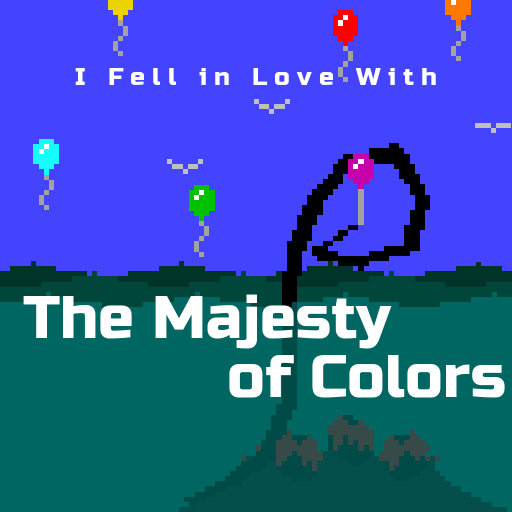 Big news! As part of Future Proof Games, I’m remastering my classic Flash art game “The Majesty of Colors” for modern technologies. Instead of Flash, the game will be available natively for Windows, OSX, Linux, iOS, and Android. We’re polishing some rough edges but otherwise staying true to the original.