The Independent Gaming Source recently finished the submission period for their Procedural Generation Competition. Contestants had about a month to begin and complete a game that created content on the fly, allowing players a different experience each time they played the game. Voting should start soon, but before then, I thought I’d highlight a few of the submissions (all free downloads or web games, of course). Click through to see a list of games I think you should check out, as well as a list of the awesomest game titles.
In this podcast, I discuss the player-author contract. An interactive work sets up a trust between the player and the work’s author. This takes the form of a contract which, when violated, can cause the player to reject the work.
The Player-Author Contract
The work can be played by the player.
Violated by games which are unexpectedly incompatible with the player’s system.
The entire work can be played by the player.
Violated by “game-breaking” bugs as in Battletoads and Pac-Man
Through playing the work, the player can affect the progression of the work.
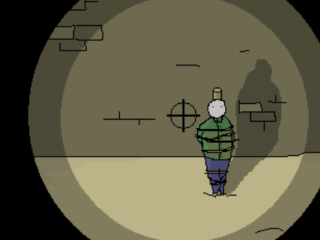
A few weeks ago, Jesse Venbrux, creator of the previously-discussedKaroshi games, released a short interactive piece called “Execution.” Not really a game, “Execution” is a quick subversion of what video games typically are and a subtle comment on the thing that the form is currently obsessed with: killing.
The impact of the game will be stronger if you play it at least twice before clicking through to the rest of the discussion. It should take you about five minutes. I’ll wait.
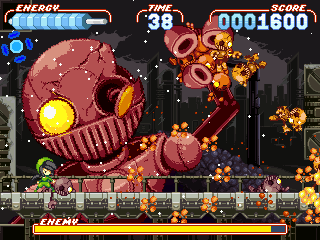
Joakim Sandberg has just released Noitu Love 2: Devolution and I highly recommend you check it out. You can pick up the demo for free, but it’s worth the $20 for the full version. It’s the answer to a single burning question: what would happen if you made a platformer that properly incorporated both mouse and keyboard? It gives three perfect answers. Click through for the discussion and minor spoilers.
Earlier this week I played a game called Yume Nikki (or Dream Diary, apparently) by Kikiyama. A post on the IndieGames.com blog turned me on to it; you can get an English translation (with complicated installation) there. The game is about a girl who refuses to leave her room and her journeys through creepy and labyrinthine dreams. The game is one of the most open and goal-less games I’ve played in a while, and it brings up some questions on the nature of goals in games. Continue reading Yume Nikki and Constraining the Player→
I just finished Karoshi 2.0 by Jesse Venbrux. It’s the sequel to the game Karoshi, which I discussed in Episode 009. It’s interesting what choices Venbrux took with this sequel; the original had gameplay centered around pushing boxes and touching switches, with rules that were generally understood by the player ahead of time. The sequel, however, is much more metatextual. Continue reading Karoshi 2.0→
At Grand Text Auto, Andrew Stern has reopened a discussion that ties into my last podcast. In that episode, I asked whether an NPC that ignored the player’s input but gave the illusion of reacting could still be called “interactive.” In his post, Stern asks a question about the other extreme. How can we allow the player to understand how the NPC’s mind works without blatantly exposing the logic?
Is the illusion of player agency as good as real player agency? Isn’t a video game just a simulated game master? Is the Chinese Room a good game? If the author is dead, what about the algorithm?