Archive for the ‘Digital Games’ Category

Ludus Novus 020: Acceptable Losses

Monday, August 23rd, 2010

In this episode of the Ludus Novus podcast, I discuss the basic minion summoning and equipment mechanics of Overlord, and how they both encourage tactical gameplay and maintain the characterization of the player character.

The music for this episode is from “medieval evil” by Baal Anamelech and is available under a Creative Commons Attribution-Sharealike 3.0 license.

Fundraising

Tuesday, August 17th, 2010

I’m thinking of doing something to bring in a bit of extra money, as things are a bit tight at the moment. One option is to sell a CD-ROM printed-on-demand containing all of my already-released games. My sponsorship agreements would allow me to do so if the games were “site-locked” to only run on a player’s own computer. I’d also make the games ad-free, of course. I could possibly offer source code, although I’d have to do something to protect my sponsors’ investment; the first thing that comes to mind would be including source code but no assets, so that the games could be examined but not easily compiled.

I could also do the same thing, but not on a physical CD; buyers would just get a DRM-free download containing the games.

Would any of the visitors to this blog be interested in some sort of merchandise along these lines? Any special requests or suggestions? Any ideas as to an appropriate price point?

[EDIT: Trythil raised a question in the comments that I should address. Games wouldn't be locked to a specific computer; they would just be prohibited from being hosted online. Specifically, some of my sponsorship agreements require advertising to be included in any widely-distributed version, and I don't want to force paying users to watch ads. I also should have said that I'd personally like to make sure ad-free versions don't get hosted on portals, as that would mean I wouldn't make money off of it. Whether you consider this "DRM" is up to you; it probably technically falls under the definition of the word. However, the package would contain no digital restrictions on copying or distribution, which is what most people think of when they say "DRM." This release would not be offered under a CC or otherwise copyleft license, so ethical restrictions would still apply to certain kinds of copying. I don't believe in enforcing those restrictions, though.]

“Narthex” Released

Wednesday, July 14th, 2010


I’ve finished up a little game that’s partially a test for a conversation engine I cooked up. It’s called “Narthex.”

After a long journey, you will reach the Narthex, the waiting place before the oracle. There you must wait until your time. Then you will be given the answer to a single question. This game has two endings. The second is not worth getting.

Play “Narthex” at Ludus Novus.

One Measure of Bit.Trip Runner

Thursday, May 27th, 2010

The other night, I picked up Gaijin Games’s Bit.Trip Runner for WiiWare. This game is the best example of pure, brilliant game design that I’ve seen in a good while. This is the game designer as teacher and leader; it’s what Anna Anthropy calls design as sadism:

As a designer and as a domme, I want the person who submits to me to suffer and to struggle but ultimately to endure: I challenge her while simultaneously guiding her through that challenge. The rules of the game and the level design carry that idea.

Runner does this through the gradual layering of new game elements, high challenge with low punishment, and optional bonus goals. Most of all, though, it guides through repetition. This is a game about rhythm, after all. For my favorite example of this, let’s look at a single measure of rhythm from the game, no longer than 2 seconds, that appears everywhere.
(more…)

Two Stories

Thursday, May 27th, 2010

For those who are interested in mixing linear prose and poetry with gaming, there’s a project that looks very interesting: “Moon Taxi,” brought to my attention by GameSetWatch. “Moon Taxi” is a game for Xbox Live Indie Games (not PC, sadly) where you play a taxi driver to the moon. Your passengers tell stories, some submitted by fans, and important words in those stories appear in front of you as you hear them. It looks very cool; a creative writing prompt and a clever way to approach storytelling all at once. Check out the recruitment video for another view at the game and a pretty funny monologue.

And for those curious about my work, my next game is almost done.

It’s about two lovers named January and September.
No, wait, it’s about a group of people who don’t believe in the sky.
No, it’s about a pantheon of scientific disciplines.
Or maybe it’s about an ancient beast who knew exactly when it was going to die, and how.

It’s about a place. A place called Looming.

Phenomenon 32 and the Cinders of Earth

Wednesday, May 19th, 2010


I’ve been playing a game lately about exploring a place where a man-made disaster has bent the very fabric of reality itself, creating bizarre anomalies and strange creatures. I explore the abandoned remnants of cities and laboratories, scrabbling for resources and seeking answers to the nature of the disaster.

This game is so good, it’s distracted me from playing STALKER.

Jonas Kyratzes‘s new game Phenomenon 32 has a similar setting to GSC Game World‘s Chernobyl shooter: the familiar modern world, distorted by the folly of science unbounded by ethics into a place where the very rules of reality can’t be trusted. This isn’t a new premise: STALKER is indirectly based on the 1972 novel Roadside Picnic, and the seminal work for this concept is probably the “Dying Earth” series. It’s sheer coincidence that I was playing these two games at the same time, but there are several good reasons why Phenomenon 32 is winning out.
(more…)

Fixing Silent Conversation

Thursday, May 13th, 2010

I like the concept behind my game “Silent Conversation.” The words of a piece form the physical structure of a level that is shaped by the setting, events, and feelings of the work’s content. Unfortunately, “Silent Conversation” is, well, not a very good game. It’s slow, because I wanted to encourage people to read the pieces. But it’s way too slow to be fun. The idea of certain words being “powerful” is promising, but the dodge-dark-red-things gameplay is more annoying than engaging.

A lot of people really resonated with the idea. I heard plenty of compliments for the visual interpretation of the text, and for making the text interesting to read, and for the potential of the game for education… but no one really said the game was fun. So here’s a question for you: how can I make a spiritual successor to “Silent Conversation” that’s actually fun? I’m seeking your help here.
(more…)

Games As Simulation

Monday, May 3rd, 2010

Games are simulations.

Games take a set of rules describing how things work, and they apply those rules to a world state to determine how that world changes over time. Sometimes the rules are very simple; “Snakes and Ladders” has about four rules. Sometimes, they are extraordinarily complex; World of Warcraft has rules that govern the actions and interactions of thousands of actors at once, with each actor having maybe a hundred different ways to affect the progress of the simulation. All games, however, share these fundamental attributes: they simulate the changes in a system over time using a set of rules.

Inherent in their status as a simulation is the fact that games are abstractions. No simulation can be an exact model of real life. Therefore, games use only a subset of the rules present in the systems they simulate. Sometimes, games simulate the real world: Roller Coaster Tycoon simulates the everyday workings of a theme park. Sometimes, they simulate a fantastic world: Morrowind is a simulation of the fictional fantasy island of Vvardenfell. Sometimes, they simulate an abstract world: Conway’s “Game of Life” simulates a world composed of either a grid of unicellular organisms, or a world of multicellular organisms with a very strange way of living. In all these cases, however, the designers of the game have chosen which rules to include in the simulation and which to abstract away. Roller Coaster Tycoon does not require the player character to get sleep. Morrowind allows the PC to eat, but does not require it. The “Game of Life” uses a very limited set of rules.

What distinguishes a game from, say, the sort of airflow simulation used by aerospace engineers? Player interaction. In games, players can modify the progress of the simulation. They can change the starting parameters, or choose what an actor will do, or even modify the rules of the simulation as it progresses. It is this interactivity that is essential to the nature of games. Games simulate worlds, but their most important property is that they allow the player to affect the simulation. It is from this ability that goals emerge, that agency arises, that fun appears. Games are simulations with life.

Waves: A Ludum Dare 17 Postmortem

Monday, April 26th, 2010


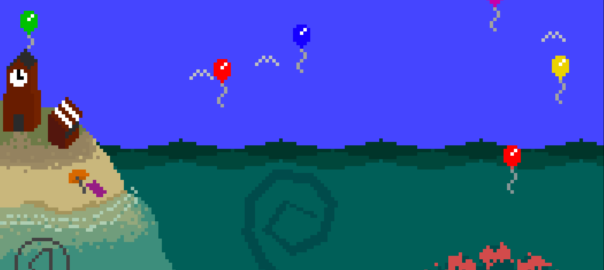
This past weekend I took part in Ludum Dare 17. Ludum Dare is a periodic informal competition where participants make a game in 48 hours based on a certain theme. This time, the theme was “Islands.” By the end of the weekend, I created a game called “Waves,” which can be played on my site. Kayla Kinnunen posted a postmortem of her own experience, and I thought it would be fun to do one of my own.

Note that the work-in-progress builds linked below will probably require you to click on the game to give it focus before it will react to your keystrokes.
(more…)

Saira

Wednesday, April 21st, 2010

Saira is an explorer. Three years ago, she was a photographer, working to take pictures of exotic and dangerous wildlife. She is brave and athletic, able to leap from rock to rock without hesitation. Her eyes are trained to notice things hidden in the world around her, and her hand is steady as she takes each picture. She can scramble up air shafts, dodge hungry wildlife, and hazard cruel environments to achieve her goals.

Saira is a character piece. (more…)